Best Stargazing Spots in Tenerife: Where to See the Stars
You leave the warm humidity of the coast around seven in the evening, wind through fragrant pine forests, and suddenly punch through a thick blanket of clouds into crisp, thin air. By the time you kill the car engine at 2,100 meters, the silence hits you first. Then your eyes adjust, and the sky opens up like an impossibly bright velvet canopy. If you are hunting down the best stargazing spots tenerife has tucked away across its volcanic peaks, you are in for an astonishing night. The island is world-renowned for good reason: the high peaks sit comfortably above the thermal inversion layer, trapping coastal moisture and city light below an ocean of white fluff.
Most travelers make the mistake of thinking you can just pull over on any random dirt shoulder along the highway. While the sky is clear almost everywhere in the national park, the topography matters. Wind conditions change fast, high rock walls can swallow half the southern horizon, and headlights from passing rental cars will ruin your night vision in three seconds flat. Here is the breakdown of the prime viewpoints, quiet pull-offs, and mountain perches where you can actually soak in the Milky Way in peace.
Book your stargazing tenerife experience:
The Central Caldera: Roques de García and Llano de Ucanca
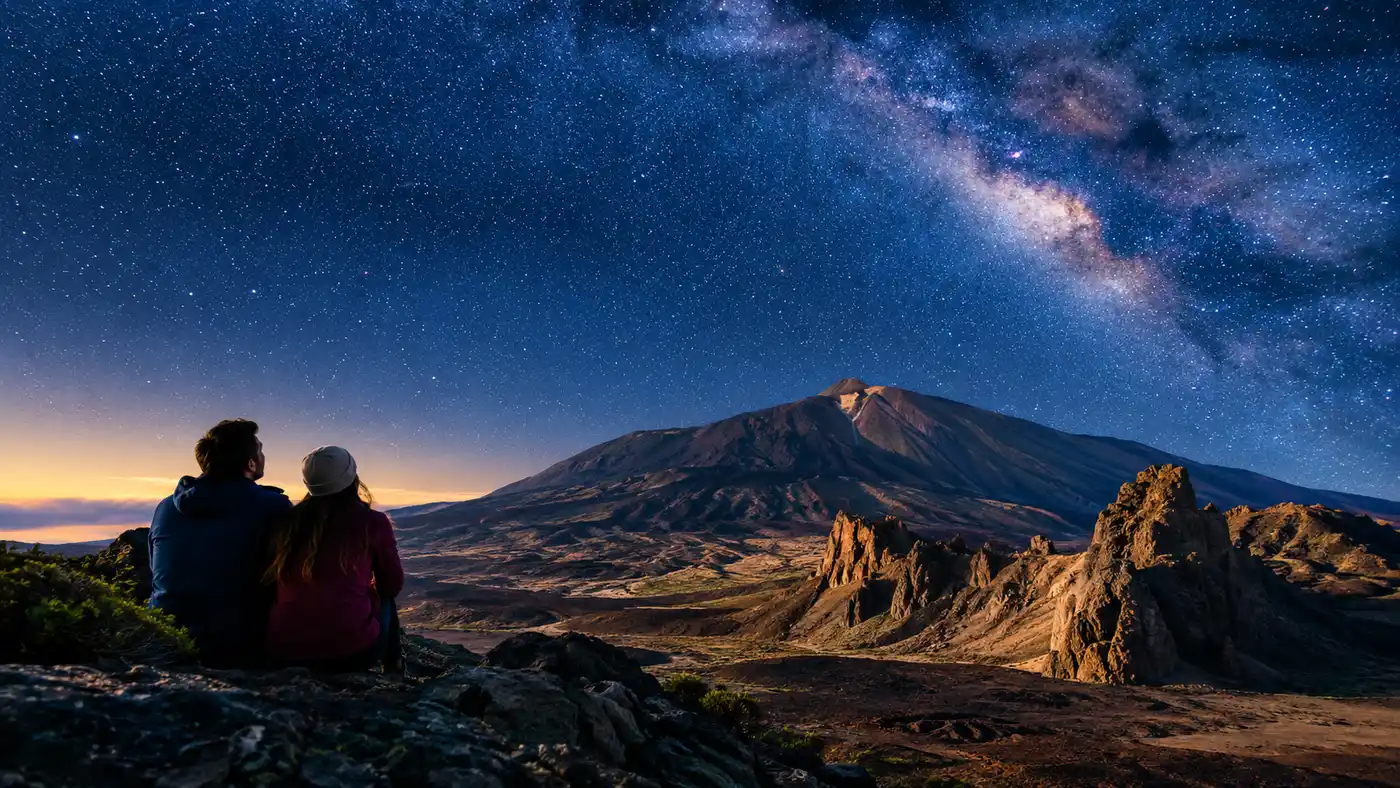
The vast floor of Las Cañadas caldera feels like the surface of the moon during the day. At night, it becomes an otherworldly natural planetarium. Llano de Ucanca is a massive, flat sediment plain sitting at roughly 2,050 meters elevation. Because the floor is so wide, you get an uninterrupted, sweeping view of the southern sky, which makes it ideal if you want to catch the galactic core during the summer months. You can pull into the roadside bays along the TF-21, step a few meters away from the tarmac, and find yourself surrounded by jagged volcanic silhouettes.
Just down the road, Roques de García offers those dramatic rock spires that everyone photographs at sunset. Most people leave immediately after the sun dips behind the horizon, which is a mistake. As darkness settles, the famous Roque Cinchado stands like a twisted finger pointing straight up at Polaris. The dirt parking lot right opposite the Parador hotel gives you direct foot access to the trails. It does get chilly here fast. The caldera acts as a cold-air sink, meaning temperatures regularly drop below 4°C even when people down in Los Cristianos are eating dinner in short sleeves.
Note: Park rangers regularly patrol the caldera turnouts. Keep your vehicle strictly within marked parking bays on paved surfaces, as driving onto the fragile pumice plains brings hefty fines from the national park authority.
If you prefer walking a bit to escape car headlights, take the path heading south toward the Ucanca plains for about five minutes. The rock walls behind you will shield the faint ambient glow leaking from the Parador, giving your eyes a chance to fully dilate. It takes about 20 minutes for human vision to adapt to genuine dark skies, so turn off your phone screen and let your pupils do the work.
High Elevation Viewpoints: The Best Stargazing Spots Tenerife Has Along the Ridges
Climbing out of the caldera basin up onto the volcanic ridges gets you away from the valley chill and provides cleaner horizons. The Mirador de las Minas de San José is my personal favorite tenerife stargazing location when the wind behaves. The landscape here is pale pumice gravel, looking eerily like a bleached desert. Because the surrounding terrain is relatively low compared to the crater rim, the sky feels huge. The parking area is spacious, set back about 30 meters from the TF-21, which keeps you reasonably protected from stray headlights.
Further west sits Mirador de Chío, perched at 2,050 meters along the TF-38 road. If you ask local amateur astronomers where to stargaze in tenerife when the trade winds are howling from the northeast, they will usually point you here. The massive bulk of Mount Teide blocks the north wind, creating a surprisingly calm microclimate on the western slopes. From this vantage point, you look out over ancient black lava fields from the 1798 Chahorra eruption, with views stretching out toward the Atlantic and the faint outlines of La Gomera and La Palma resting on the horizon.
| Stargazing Spot | Elevation | Facing Direction | Drive Time from Adeje | Best For |
|---|---|---|---|---|
| Llano de Ucanca | 2,050 m | South / Open | 45 mins | Milky Way core & wide horizons |
| Mirador de Chío | 2,050 m | West / Southwest | 40 mins | Sunset into star transition & wind shelter |
| Minas de San José | 2,250 m | East / Overhead | 55 mins | Meteor showers & lunar landscapes |
| Mirador de La Tarta | 2,140 m | North / East | 70 mins | Seeing the sea of clouds below the stars |
| Mirador de Boca Tauce | 1,980 m | South / Southwest | 35 mins | Quick access from southern resorts |
Near the highest paved point on the island, near the famous astrophysical facility, you reach the ridge around Izaña. The atmosphere here is remarkably stable, which is exactly why international researchers built giant solar and nocturnal telescopes along this spine. While the research complex itself is gated at night, the nearby roadside lookouts along the TF-24 provide some of the clearest seeing conditions on planet Earth. You can read up on visiting the science facilities during daylight in our guide to Teide Observatory tours and visiting hours.
Escaping the Coast: Stargazing in Tenerife South and Costa Adeje
Let us be realistic about light pollution: you cannot do serious stargazing tenerife costa adeje style directly from your hotel balcony. The southern resort strip stretching from Los Cristianos through Las Américas to Costa Adeje blazes with neon, street lamps, and hotel pools. Trying to pick out constellations from the beach is frustrating. However, the geographic beauty of Tenerife is how rapidly the volcanic terrain rises out of the ocean.
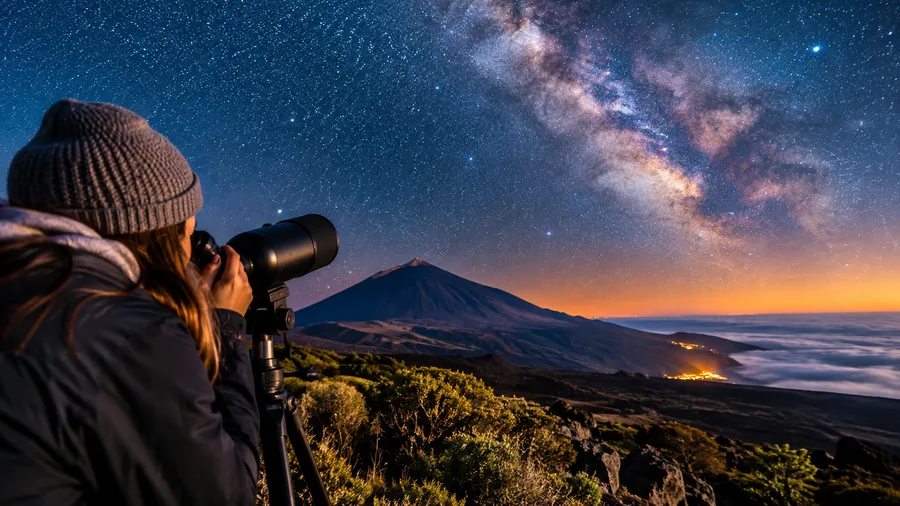
To find proper stargazing spots tenerife south visitors can reach without spending half the night behind the wheel, take the TF-51 highway straight up through Arona toward Vilaflor. Vilaflor is the highest village in Tenerife, sitting at around 1,400 meters. The moment you drive past the town and enter the pine belt (known locally as the Corona Forestal), the artificial light drops dramatically. Keep climbing until you reach the Mirador de Boca Tauce at the junction of the TF-21 and TF-38. It takes barely 35 minutes from the coast.
Pro tip: Fill your fuel tank in Adeje or Vilaflor before heading up. There are zero petrol stations inside the national park, and mountain driving burns fuel nearly twice as fast as coastal cruising.
Boca Tauce is arguably the most convenient stargaze point tenerife provides for southern holidaymakers. You park near the intersection where an old stone trail marker stands, surrounded by dark basalt fields. Looking south, the resorts are completely hidden under the cloud blanket below 1,200 meters. If you are planning an independent trip up the mountain, check our detailed walkthrough on self-drive stargazing in Tenerife for route breakdowns and safety advice.
Book your stargazing tenerife experience:
Approaching the Peaks: Stargazing Tenerife From Puerto de la Cruz and the North
Coming from the green, humid north of the island involves a completely different journey. Leaving Puerto de la Cruz or La Orotava, you take the winding TF-21 through dense laurel and pine forests. You will often hit thick fog between 800 and 1,500 meters. Do not let that discourage you. The moisture is trapped under the trade-wind inversion layer, and once your car breaks through into the subalpine zone at El Portillo, the sky clears instantly into pristine indigo.
Once past the visitor center at El Portillo, the road splits. Taking the TF-24 ridge road toward Santa Cruz brings you to Mirador de La Tarta. This spot gets its name from the layered volcanic ash cut open by road builders, resembling a multi-tiered cake with white, black, and red pumice stripes. At night, you cannot see the colors, but the lookout points eastward over the Valle de La Orotava. On clear nights with low inversion, you will see a brilliant sea of white clouds glowing softly below under the starlight, with the peak of Gran Canaria sticking out in the far distance.
Preparation makes the difference between an unforgettable evening and shivering miserably inside a rental car. Here is what you must throw in the trunk:
- Warm clothing layers: a fleece, a windproof outer jacket, a wool hat, and gloves, because high altitude temperatures drop below freezing from November through April.
- Red-beam headlamp: white phone lights ruin your night vision for 20 minutes, whereas red light preserves your dark adaptation.
- Thermal flask with hot tea: standing motionless outdoors at 2,200 meters drains body heat surprisingly fast after an hour.
- Sturdy footwear: volcanic pumice and loose basalt scree will shred thin flip-flops and roll ankles in the dark.
- Offline star maps: mobile reception inside the caldera basin can be patchy, so download astronomical apps like Stellarium beforehand.
Alternative Corners: Teno and Anaga Outside the National Park
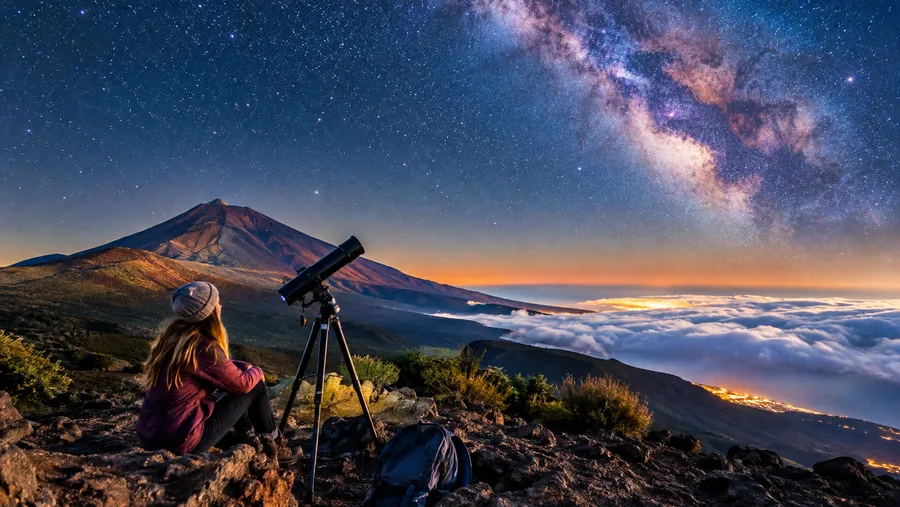
Teide gets all the glory, but there are other tenerife best places stargazing enthusiasts can explore if they want a raw, coastal mountain atmosphere. The Teno Rural Park in the northwest corner of the island has remarkably dark skies because it is cut off from the main metropolitan centers by dramatic volcanic ravines. Mirador de Cherfe, located along the narrow road down to Masca village, offers a wild stargazing location overlooking deep gorges and the Atlantic ocean.
The trade-off in Teno is the cloud cover. Unlike the high caldera, which sits comfortably above 2,000 meters, Teno peaks hover between 800 and 1,100 meters. That means the trade clouds often wrap around the ridge lines, coating everything in thick, cool mist. You have to check local weather webcams before driving up. When the air is dry and the wind blows from the south or east, Cherfe becomes magical, with almost zero light pollution to the west over the open ocean.
The Anaga peninsula in the far northeast is another curious option, though it requires strict attention to the forecast. The Mirador de Jardina and the heights around Chinamada occasionally sit above the marine fog layer. However, humidity here is notoriously high. Moisture in the air scatters faint light and fogs camera lenses rapidly. Honestly, unless you are staying in the north and just want a quick 20-minute drive into the mountains, you are far better off driving an extra half hour up to the national park where dryness is practically guaranteed.
When you are scouting where to stargaze tenerife landscapes quietly, following basic field etiquette ensures everyone has a peaceful night:
- Douse car headlamps quickly: use parking lights as soon as you turn into a designated viewing pull-off so you do not blind observers.
- Keep voices down: sound travels vast distances across the empty caldera floor, and many people visit to experience the profound mountain silence.
- Pack out every scrap: there are no rubbish bins at isolated viewpoints, and winds easily carry lightweight plastic wrappers across protected habitats.
- Stick to established paths: the rare alpine flora, like the delicate Teide violet and bugloss seedlings, takes years to recover from heavy boots.
Frequently Asked Questions about best stargazing spots tenerife
What is the absolute best place to stargaze tenerife has for beginners?
The parking area at Mirador de Chío along the TF-38 road is the easiest and most comfortable option. It has smooth asphalt, plenty of parking spaces, easy road access from the southern resorts, and wide-open horizons protected from prevailing winds by Mount Teide.
Can you see the Milky Way clearly with the naked eye from Tenerife?
Yes, between May and September the galactic center is intensely visible to the naked eye from anywhere inside Las Cañadas del Teide. On moonless nights, the cosmic dust lanes and star clusters appear sharp enough to cast subtle shadows across the pale pumice sands.
Do I need a special permit to visit the stargazing viewpoints at night?
No permit is required to drive the public highways (TF-21, TF-24, TF-38) or to stop at the roadside viewpoints inside Teide National Park at night. You only need a daytime hiking permit if you plan to climb the final cone to the summit peak of Mount Teide.
How cold does it actually get at the mountain stargazing spots?
During the summer months, night temperatures typically hover between 8°C and 12°C. Between November and April, temperatures frequently drop between -2°C and 4°C, occasionally accompanied by sharp mountain winds and frost, requiring full winter gear.
Quick Reference
- Best overall zone: Las Cañadas caldera (above 2,000 meters)
- Top wind-sheltered lookout: Mirador de Chío (TF-38)
- Fastest route from south coast: TF-51 via Vilaflor to Boca Tauce (35 mins)
- Peak Milky Way viewing season: June to August during new moon
Book your stargazing tenerife experience:
Before You Head Up
The night skies above Tenerife will spoil you for city living forever. Looking up from the edge of Llano de Ucanca into thousands of brilliant pinpricks makes the everyday rush down at the beach clubs feel a million miles away. Just remember to time your trip around the lunar calendar; a brilliant full moon will wash out faint nebulae just as thoroughly as street lamps. Pack a heavy jumper, grab a thermos of coffee, and give yourself plenty of time to sit back and watch the shooting stars streak across the volcanic ridge.
Read more about stargazing tenerife.